ハイライト:
Luminol
, 521-31-3
, chemiluminescence reagents
The underestimated variable pH controls the luminescent lifeline of luminol
In the wonderful world of chemiluminescence, luminol, with its unique blue glow, has become an indispensable "pursuer" in fields such as criminal investigation and biological analysis. However, many people often overlook the most fundamental and critical variable - pH value - when focusing on its sensitivity and reaction system. This seemingly simple acid-base indicator is actually the core lifeline that controls whether luminol can stably and continuously emit light, directly determining the success or failure of the experiment and the reliability of the data.
|
Product Name
|
Luminol/3-aminobenzoyl hydrazine/luminescent ammonia
|
CAS Number
|
521-31-3
|
|
Product Appearance
|
off-white powder
|
Molecular Formula
|
C8H7N3O2
|
|
Luminescence detection
|
Fluorescence wavelength is 425nm
|
Molecular Weight
|
177.16
|
|
Standard Packaging
|
50g/bottle
|
Storage Conditions
|
Sealed, away from light and moisture
|
|
Manufacturer
|
Hubei Xindesheng Material Technology Co., Ltd
|
Acid base polarization: the "invisible switch" of luminol luminescence
Numerous studies have confirmed that the pH environment of the reaction system plays a decisive regulatory role in the luminescence intensity of luminol. When the system is at different pH levels, luminol seems to be triggered by different switches, presenting two completely opposite states. In a slightly acidic environment, the ionization process of luminol molecules is inhibited, and their efficiency in reacting with oxidants is significantly reduced, resulting in a very weak luminescence signal that we ultimately observe. When the system shifts to an alkaline environment, the situation reverses and the luminescence efficiency of luminol is fully released, resulting in a significant increase in signal intensity.

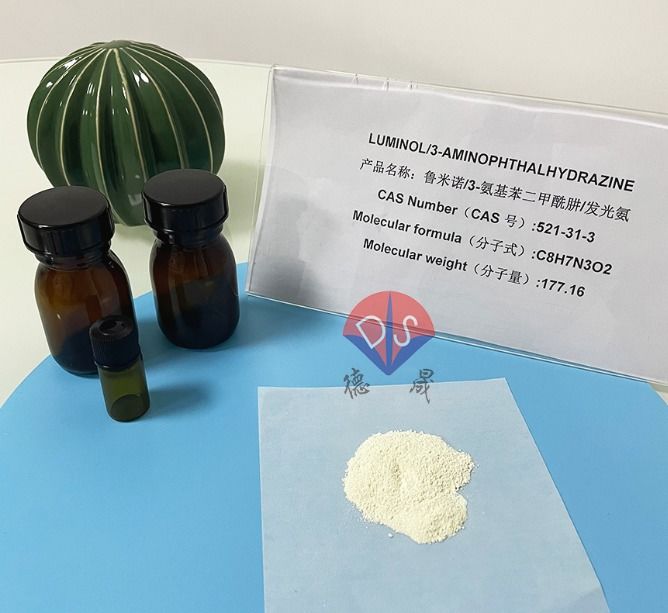
luminol powder
The significant differences observed at different pH levels reveal a core principle: in order for luminol to exhibit ideal luminescent properties, selecting suitable oxidants and catalysts alone is not enough. Matching it with a suitable alkaline environment is the fundamental prerequisite for unleashing its luminescent potential.
Golden Window: Capturing Stable and Persistent Balance between pH 8.0 and 9.5
Further kinetic studies have depicted the activity spectrum of luminol luminescence for us. The data shows that within the pH range of 8.0 to 9.5, the luminescence performance of luminol enters its high light moment. This interval not only ensures the smooth progress of molecular ionization and oxidation reactions, but also provides ideal conditions for the stability of luminescence.
When we compare the performance of different pH points within this range, interesting differences become apparent. At pH 8.0, although luminol can emit light, its initial intensity is relatively restrained, and the signal undergoes a significant attenuation process. Its luminescence half-life is about 20 minutes, exhibiting a brief and stable characteristic. However, when we adjusted the reaction system to pH 9.5, the situation was quite different. Luminol's initial luminescence intensity significantly increases in this environment and exhibits surprising persistence. Its signal does not quickly dissipate after a rapid outbreak, but slowly weakens in a stable state at a high level. Even after 3 hours of reaction initiation, its luminescence intensity can still maintain around 30% of the initial value, providing a sufficient window for experiments that require long-term observation. It can be said that under alkaline conditions of pH 9.5, the luminescence signal of luminol truly achieves the ideal combination of high intensity and high stability.
In summary, pH value is not an auxiliary parameter that can be arbitrarily set, but rather the underlying logic that determines the luminescence performance of luminol. For researchers who pursue precision and efficiency, controlling the reaction system within an appropriate alkaline range is a practical choice to unleash the maximum potential of luminol and obtain reliable data. Next time you debug the luminescent system, why not ask yourself: Have I found the "best partner" for pH for luminol?
Product packaging
Hubei Xindesheng Material Technology Co., Ltd. specializes in the production of chemiluminescence reagents such as luminol. With advanced production equipment and rich production experience, our professional technical team ensures product quality and can provide good after-sales service and customized services. If you have any related procurement needs in the near future, please click on the official website for more details or contact me directly!


 メッセージは20〜3,000文字にする必要があります。