logo
Wuhan Desheng Biochemical Technology Co., Ltd
製品
家へ /

製品

Precise Regulation, Stable Protection—The Scientific Approach to MOPS Buffer Concentration Selection

製品詳細

起源の場所: hubei

ブランド名: desheng

証明: ISO9000

モデル番号: アル

支払いと送料の条件

最小注文数量: 20kg

価格: Detailed discussion

パッケージの詳細: 25kg/バレル

受渡し時間: 3日間

支払条件: L/C、T/T、D/P、ウェスタン・ユニオン

供給の能力: 1t/日

最もよい価格を得なさい
今連絡してください
仕様
ハイライト:

Analytical pure reagent

,

High purity reagent

,

Biological buffer

カス:
1132-61-2
外観:
白い粉
包装:
25kg/バレル
エイリアス:
MOPS バッファ
カス:
1132-61-2
外観:
白い粉
包装:
25kg/バレル
エイリアス:
MOPS バッファ
記述
Precise Regulation, Stable Protection—The Scientific Approach to MOPS Buffer Concentration Selection

In biochemical and molecular biology experiments, the selection and preparation of buffer solutions are often the fundamental steps to ensure the reliability of experimental results. Among them, MOPS buffer(3- (N-morpholino) propanesulfonic acid) is widely used as a zwitterionic buffer in various experimental scenarios such as cell culture, protein electrophoresis, and nucleic acid analysis due to its stable buffering ability and low metal ion binding properties within the physiological pH range. This article will focus on the key variable of concentration, explore its impact on the stability of MOPS buffer, and provide scientifically reasonable selection recommendations.  


Product Name

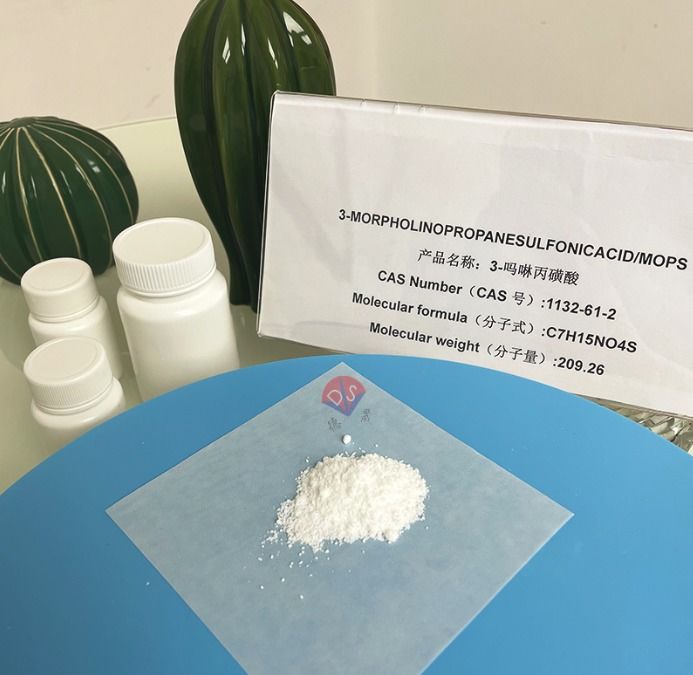
3-morpholinopropane sulfonic acid

Chemical Abbreviation

MOPS buffer

CAS Number

1132-61-2

Product Appearance

Pure white crystalline powder

Molecular Weight

two hundred and nine point two six

Molecular Formula

C7H15NO4S

Storage Conditions

Room temperature, away from light and moisture

Purity

More than 99%

Standard Packaging

500g/bottle, plastic bottle

Manufacturer

Hubei Xindesheng


1, The mechanism of action and concentration significance of MOPS buffer solution


MOPS belongs to the Good's buffer family, and its effective buffering range is usually between pH 6.5-7.9, making it particularly suitable for maintaining the acid-base balance of the system under neutral to weakly alkaline conditions. Concentration is not only a quantitative indicator for buffer preparation, but also a key factor directly affecting its ion strength, osmotic pressure, and buffer capacity. Appropriate concentration can ensure that the buffer effectively counteracts pH fluctuations caused by the addition of metabolites or reagents during the experimental process, thereby providing a stable environment for biochemical reactions.


Precise Regulation, Stable Protection—The Scientific Approach to MOPS Buffer Concentration Selection 0

MOPS buffer


In practical applications, the working concentration of MOPS buffer is generally controlled within the range of 20-50 mM. This concentration range can balance buffering efficiency and system compatibility, and exhibits reliable pH maintenance ability under most experimental conditions. If the concentration is significantly lower than this range, the buffer's ability to resist external acid-base interference may decrease, leading to an increased risk of pH shift; However, excessive concentration may introduce unnecessary ion effects and even interfere with certain enzymatic reactions or molecular interactions. Therefore, concentration selection essentially seeks a balance between buffer capacity and system compatibility.


2, Potential impact of insufficient concentration on experimental stability


When the concentration of MOPS buffer solution is too low, its internal buffer capacity may not be sufficient to cope with external acid-base changes. For example, during cell culture, cell metabolism produces acidic products; In biochemical reactions, the addition of reagents may also alter the concentration of hydrogen ions in the reaction solution. If the buffer concentration is insufficient, the pH value of the system is prone to slow drift, which may affect cell activity, enzyme kinetics, or nucleic acid hybridization efficiency.


In addition, low ion strength sometimes cannot provide sufficient charge shielding for certain proteins or nucleic acids, which may lead to non-specific aggregation or adsorption of biomolecules, thereby interfering with detection results. Therefore, in experimental procedures involving precise quantification or long-term incubation, it is necessary to carefully evaluate the minimum effective concentration of the buffer to avoid introducing systematic errors due to insufficient concentration.


3, Experimental challenges that may arise from excessive concentration


On the other hand, when the concentration of MOPS buffer is significantly higher than the conventional range, although it may increase the buffer reserve of the system, it also brings a series of operational and interpretive complexities. High concentration buffer solutions are usually accompanied by higher ionic strength, which may alter the osmotic pressure of the solution and affect cell volume and function in cell experiments; In electrophoresis experiments, it may affect the electric field distribution and molecular migration rate.


Some biochemical reactions that are sensitive to ionic environments, such as PCR, restriction enzyme digestion, or protein folding studies, may also be inhibited by high concentration buffer solutions. In addition, high concentration reagents may increase the viscosity of the solution, affect the accuracy of sample addition and mixing efficiency, and even increase experimental costs. Therefore, blindly increasing concentration is not a universal strategy for improving stability, but needs to be optimized in conjunction with specific experimental systems.


4, Rational balance, scientific adaptation


In summary, the concentration selection of MOPS buffer is an experimental design process that requires comprehensive consideration of multiple factors. Reasonably adjusting the concentration within the conventional range of 20-50 mM can effectively improve the repeatability and reliability of the experiment. Researchers should have a deep understanding of the chemical and biological characteristics of their experimental systems, avoid mechanically applying generic formulas, and find the optimal combination point between buffer capacity and system compatibility through system optimization, in order to provide solid and stable technical support for scientific research.


Precise Regulation, Stable Protection—The Scientific Approach to MOPS Buffer Concentration Selection 1

Product packaging


As a MOPS raw material manufacturer, Desheng can supply analytical pure powder, which is easy to prepare and use, follows the preparation steps, and will not have high or low concentrations. And the company has professional personnel to answer relevant questions in a timely manner, allowing customers to use with confidence and peace of mind. If you are interested, please click on the website to inquire about details and make a purchase!


問い合わせを送信する
ご要望を 送信してください できるだけ早く 返信します
送信する